
Not long ago, I visited a commercial building where the facility manager proudly showed me their brand-new electrical room. Everything looked impressive.
+ Modern switchgear.
+ Powerful transformers.
+ Backup generators.
+ UPS systems.
+ Air conditioning.
+ CCTV.
Yet when I asked a simple question –
“If one of these power panels begins overheating at 2:30 in the morning, who will know before it catches fire?” He smiled.
“No one… unless something actually happens.”
That answer stayed with me. Because the reality is this: many modern buildings still depend on people discovering problems after they have already become dangerous. And unfortunately, history has shown us how expensive that approach can be.
Electricity is a Wonderful Servant—But a Dangerous Master
Almost every modern building today depends on electricity.
> Hospitals.
> Factories.
> Shopping malls.
> Hotels.
> Data centres.
> Office buildings.
> Airports.
Everything runs because electricity keeps flowing. But electricity has no mercy.
A loose cable…, An overloaded circuit…, A failed cooling fan…, A leaking transformer…, An overloaded UPS…, An unnoticed voltage fluctuation…
Any one of these can become the beginning of a disaster.
We Have Seen These Disasters Too Many Times
Every year, somewhere in the world, buildings are severely damaged because of electrical failures. A small electrical short circuit spreads inside a cable tray.
Nobody notices.
+ Heat keeps increasing.
+ Smoke develops.
+ Fire suppression activates too late.
+ Business operations stop.
+ Critical systems go offline.
+ Patients must be evacuated.
+ Production lines stop.
+ Servers become unavailable.
+ Millions of dollars disappear in a matter of hours.
+ Sometimes the building survives.
+ Sometimes it doesn’t.
And sadly, lives are occasionally lost as well. The frightening part is that many of these incidents were preventable.
Buildings Should Not Wait for Humans to Notice Problems
Imagine driving your car. Would you prefer the engine to explode first…, or receive a warning saying:
“Engine temperature is rising.” Of course, everyone would choose the warning. Modern buildings deserve the same intelligence. This is exactly where the Internet of Things (IoT) changes everything.
A Building That Never Sleeps
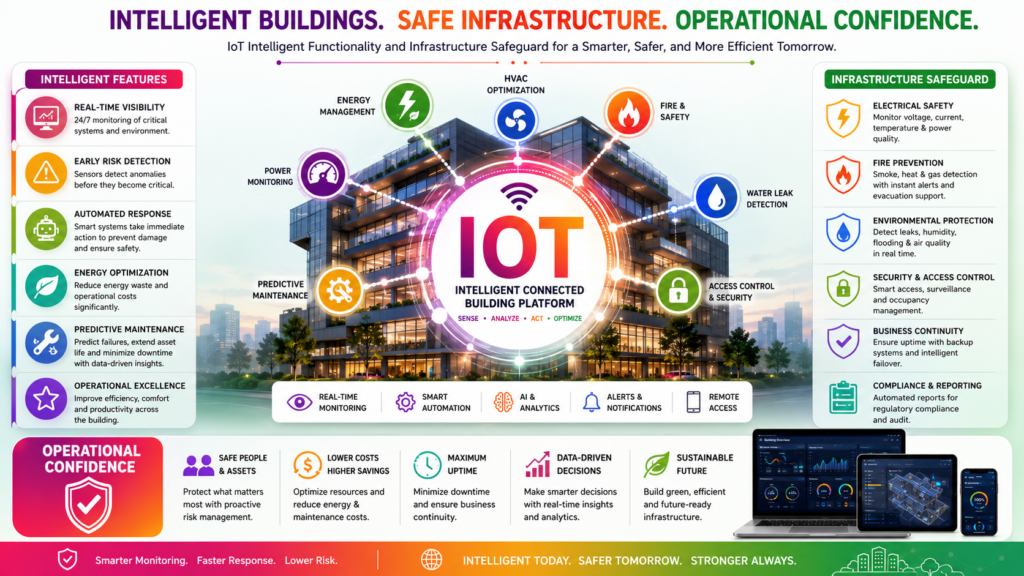
Think of IoT as giving thousands of tiny eyes and ears to a building. Instead of depending on a security guard walking around every few hours, hundreds—or even thousands—of intelligent sensors continuously watch everything happening inside the building.
They never become tired. They never take lunch breaks. They never forget. They work twenty-four hours a day. Every day. Every year.
What Can IoT Actually Monitor?
Much more than most people imagine. A modern Intelligent Building Management System can continuously monitor:
- Incoming electrical supply quality
- Voltage imbalance
- Current consumption
- Power factor
- Frequency variation
- Harmonic distortion
- Transformer temperature
- Busbar temperature
- Cable overheating
- Generator performance
- UPS health
- Battery condition
- Water leakage
- Smoke and fire indicators
- Room temperature
- Humidity
- Server room cooling
- Air quality
- Occupancy levels
- Lighting usage
- HVAC performance
- Elevator health
- Water pumps
- Fuel levels
- Diesel generator status
- Solar power generation
- EV charging stations
And all of these measurements are collected every few seconds. Not once a month. Not once a week. Every few seconds.
The Building Begins to Think
Now imagine this. It is 2:17 AM. Nobody is inside the electrical room. One cable termination begins becoming loose. Its temperature slowly rises from:
45°C…, 60°C…, 75°C…, 90°C…
Without IoT, nobody knows. Eventually insulation melts. A short circuit occurs. Fire starts. With IoT? The temperature sensor immediately notices the abnormal increase.
The system automatically sends alerts to:
- Facility Manager
- Maintenance Engineer
- Security Control Room
- Mobile phones
- SMS
- WhatsApp (through integration)
If configured, the system can even:
- disconnect the faulty circuit,
- activate ventilation,
- switch to backup power,
- trigger alarms,
- notify emergency response teams.
The incident is prevented before becoming a disaster.
IoT Doesn’t Only Protect Buildings—It Saves Money Too
Many people believe IoT is only about safety. Actually, its financial benefits are equally impressive. Take lighting as an example. Walk into many office buildings after office hours. You’ll often find:
Meeting rooms fully lit with no one inside.
Air conditioners cooling empty offices.
Parking areas brightly illuminated all night.
Unused equipment still running.
Water pumps operating longer than necessary.
Every unnecessary kilowatt means unnecessary cost.
IoT changes that completely.
Occupancy sensors automatically detect whether a room is being used.
If nobody is present:
Lights turn off.
Air conditioning adjusts automatically.
Ventilation slows down.
Power consumption drops immediately.
The building becomes intelligent enough to avoid wasting electricity.
Real-Time Energy Intelligence
Traditional electricity bills tell you only one thing:
How much electricity you used last month. That information comes too late. IoT tells you something much more valuable. It tells you right now.
Which floor is consuming excessive power?
Which machine is inefficient?
Which department wastes the most electricity?
Which air conditioning unit is beginning to fail?
Which transformer is overloaded?
Which motor consumes unusually high current?
Instead of guessing… Facility managers can finally make decisions using real data.
Predictive Maintenance Instead of Emergency Repairs
One of my favourite capabilities of IoT is predictive maintenance.
Traditional maintenance usually works like this:
Equipment
Runs…, Runs…, Runs…
Then suddenly fails. Everyone rushes to repair it. This is expensive. IoT changes the philosophy. It continuously learns equipment behaviour. A motor beginning to vibrate more than normal. A bearing becoming hotter. A pump drawing more current. A UPS battery losing capacity.
The system identifies these trends weeks or even months before failure. Maintenance becomes planned instead of reactive. Downtime reduces dramatically.
A Hospital is a Perfect Example
Consider a modern hospital. Electricity isn’t just about keeping the lights on.
+ It supports:
+ Life-support systems.
+ Operating theatres.
+ MRI scanners.
+ ICUs.
+ Dialysis machines.
+ Laboratories.
+ Medical refrigerators.
+ Network infrastructure.
+ Patient monitoring systems.
A few seconds of unexpected power interruption can directly affect patient care.
IoT continuously supervises generators, UPS systems, battery banks, transformers, cooling systems and electrical distribution. If any parameter drifts beyond a safe operating range, engineers are alerted immediately. Combined with intelligent automation, backup systems can start automatically and loads can be transferred without manual intervention, reducing risk and helping ensure continuity of critical healthcare services.
IoT + Artificial Intelligence: The Next Step
Today, IoT generates enormous amounts of operational data. Artificial Intelligence takes this one step further. Instead of only showing alarms, AI begins answering questions like:
“Transformer No. 2 has shown a gradual increase in operating temperature over the past three weeks. Based on historical patterns, there is a high probability of insulation degradation. Inspection is recommended within the next five days.”
That is no longer monitoring. That is intelligent decision support.
The Future Has Already Arrived
Twenty years ago, CCTV transformed physical security. Today, IoT is transforming operational safety. Buildings are no longer just concrete, steel and cables. They are becoming living digital ecosystems that continuously sense, analyse and respond to their environment. The smartest buildings are not necessarily the ones with the most expensive equipment. They are the ones that can detect a problem before people even know it exists.
And in my opinion, that is where every modern building should be heading.
Whether it’s a hospital, factory, university, shopping mall, hotel or corporate office, IoT is no longer a luxury or a futuristic concept. It has become a practical investment in safety, operational resilience and energy efficiency. The organisations that adopt it today won’t just reduce electricity bills—they’ll build safer workplaces, extend the life of critical equipment, minimise unplanned downtime and gain the confidence that their facilities are being watched every second of every day.
In the end, the greatest value of IoT isn’t the technology itself. It’s the peace of mind that comes from knowing your building is always watching over itself—even when no one else is.