
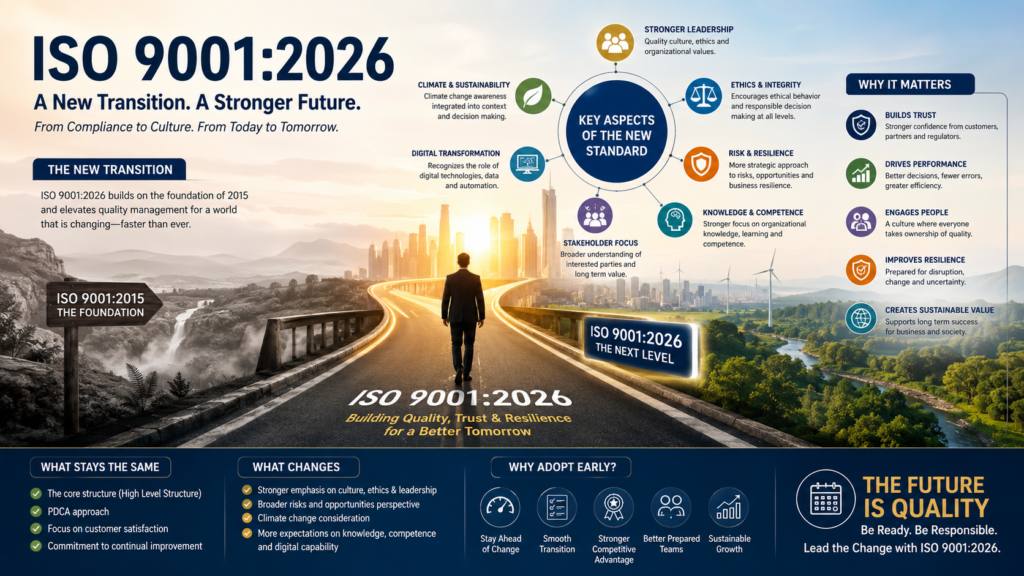
When ISO 9001:2015 came out, the business world was quite different. AI was not mainstream, cloud computing was still growing, remote work was rare, supply chain disruption was not a daily discussion, and climate change was not yet considered a business governance issue.
Fast forward to 2026.
Today almost every organization depends on digital technology, data, AI, outsourcing, global suppliers, cybersecurity, resilience and sustainability. ISO simply cannot ignore these realities anymore.
The good news is this:
ISO 9001:2026 is NOT a brand-new standard.
If someone is expecting another revolution like the jump from ISO 9001:2008 to 2015, they will probably be disappointed. This is more like taking a modern house and renovating it with smarter wiring, stronger foundations and better security rather than demolishing everything and rebuilding from scratch. (ISO)
First… the structure remains almost identical
One thing I personally like is that ISO did not disturb the familiar High Level Structure. It still follows:
- Clause 4 — Context of the Organization
- Clause 5 — Leadership
- Clause 6 — Planning
- Clause 7 — Support
- Clause 8 — Operation
- Clause 9 — Performance Evaluation
- Clause 10 — Improvement
So organizations will not need to redesign their QMS documentation from zero. The familiar PDCA structure introduced in ISO 9001:2015 remains the backbone. (ISO)
So what actually changes?
From everything released so far, the revision is strengthening several themes rather than inventing completely new clauses.
1. Leadership becomes much stronger
In 2015, leadership was mainly about commitment. In 2026 it becomes more about creating quality culture. Top management will be expected to demonstrate that quality is not only documented but embedded into the organization’s behaviour. Questions like these become important:
| Do employees actually care about quality? |
| Does management encourage ethical decisions? |
| Are people comfortable reporting mistakes? |
That is a much deeper expectation than simply signing the Quality Policy.
2. Ethics enters ISO 9001
This is probably the biggest philosophical change. Quality is no longer viewed only as producing conforming products. Organizations are expected to encourage ethical behaviour in decision making.
Imagine:
A supplier can secretly use lower-quality raw materials. The product may still pass inspection. But ethically, the organization knows it is wrong. ISO now wants leadership to build a culture where people choose the right decision—not only the profitable one.
3. Organizational Culture
Personally I think this will become one of the most audited areas. Auditors will increasingly ask:
“How do employees participate?”
“How are improvement ideas encouraged?”
“How do departments work together?”
|Culture cannot be written in a procedure.
It has to be visible.
4. Climate Change is no longer optional
Actually this journey already started. In 2024 ISO amended Clause 4.1 and 4.2 requiring organizations to consider climate change when determining organizational context and interested parties. The 2026 edition simply integrates that amendment into the standard itself. (ISO)
That doesn’t mean every company must become “green.”
It simply asks:
Can climate change affect our organization? For some organizations the answer may be:
- power shortages
- flooding
- extreme weather
- supplier disruption
- transportation delays
- regulatory changes
For others, the answer may genuinely be “not significant.” The important part is that the organization has actually considered it.
5. Risk becomes more mature
ISO 9001:2015 introduced risk-based thinking. Many organizations treated it like another risk register. The new edition is expected to make organizations think beyond simple operational risks.
For example:
- geopolitical risks
- technology risks
- supplier dependency
- cyber risks
- resilience
- long-term organizational sustainability
Risk becomes more strategic.
6. Digital Transformation
This is another expected emphasis. Back in 2015 many organizations still relied on paper. Today almost every process is digital.
+ Enterprise Resource Planning (ERP)
+ Customer Relationship Management (CRM)
+ Cloud Technology
+ Artificial Intelligence (AI)
+ Internet of Things (IoT)
+ Process Automation
+ Digital Records
The revised standard recognizes that quality management now lives inside digital systems.
7. Knowledge becomes more valuable
ISO 9001:2015 introduced Organizational Knowledge. The 2026 version is expected to strengthen it further.
Think about a hospital. One senior nurse retires. Twenty years of experience disappears. Nothing was documented. That is organizational knowledge loss. Future audits will probably look more seriously at knowledge capture and succession planning.
8. Interested Parties become broader
Customers remain important. But organizations will increasingly consider:
- regulators
- communities
- suppliers
- shareholders
- employees
- technology partners
Quality is no longer only about satisfying customers. It is about sustaining the whole business ecosystem.
Will there be new clauses?
Probably not. Clause numbers remain the same. Instead, many requirements become richer and clearer. Think of it like replacing old furniture inside the same house. The rooms stay where they are. The contents become smarter.
What does this mean for auditors?
Honestly…
The audit interview style will probably change more than the checklist. Instead of asking:
“Show me your procedure.”
Auditors will ask:
- How do people make decisions?
- How do you encourage ethical behaviour?
- How do employees report problems?
- How do digital systems support quality?
- How does top management create a quality culture?
- How do you identify future business risks?
That is a very different conversation.
My personal observation
After auditing banks, hospitals, software companies and manufacturing industries over the years, I actually welcome this revision.
One thing I have repeatedly noticed is that many organizations have excellent documentation. Beautiful SOPs. Wonderful Quality Manuals. Perfect forms. But when you walk into the operation. People don’t follow them. That gap between “documented quality” and “living quality” is exactly what ISO 9001:2026 seems to be trying to close.
The standard is slowly moving away from asking,
“Do you have a Quality Management System?”
and moving toward asking,
“Does quality genuinely shape the way your organization thinks and behaves?”
To me, that is the real story behind ISO 9001:2026. It isn’t trying to make organizations write more documents. It is trying to make quality become part of everyday business decisions. (ISO)