
Precision Agriculture, AI & IoT Farming Solutions | OpenmindConnect
Explore AI, IoT, smart irrigation, soil monitoring, weather intelligence, crop analytics, drones and livestock monitoring solutions for productive and sustainable agriculture.
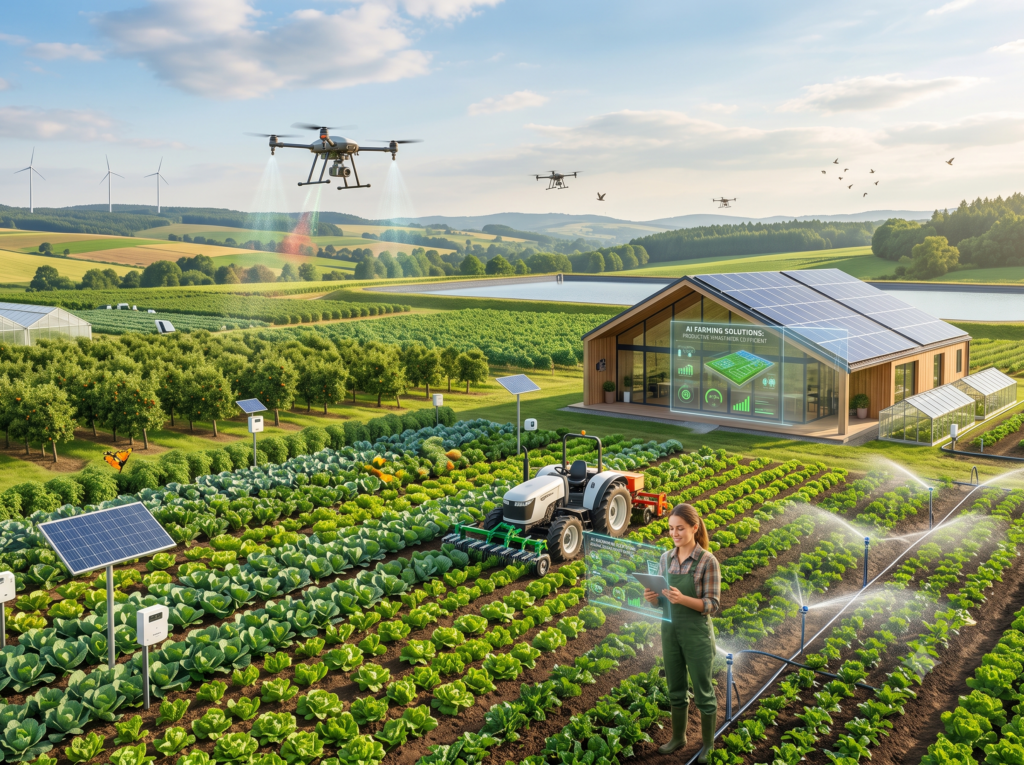
AI & IoT Solutions for More Productive, Resource-Efficient and Resilient Farming
Agriculture has always depended on experience, observation and an understanding of nature. These remain essential. But today, farmers and agricultural organizations must also deal with unpredictable weather, water scarcity, rising input costs, labour shortages, crop disease, soil degradation and pressure to produce more from limited land.
Precision Agriculture brings together IoT sensors, weather stations, smart irrigation, drones, satellite information, AI analytics and automated controls to help farmers understand what is happening in their fields and respond at the right time.
OpenmindConnect helps agricultural businesses, farms, development projects, research organizations and public institutions identify suitable technologies, evaluate global solution providers and develop practical implementation plans based on crop, location, budget and operational requirements.
Why Precision Agriculture Matters
A whole field may be irrigated even though some areas are already wet. Fertilizer may be applied uniformly although soil conditions differ from one location to another. Pest or disease problems may only become visible after they have already affected a significant part of the crop.
Precision Agriculture helps make these invisible differences visible.
It can help organizations:
✓ Understand real-time soil conditions
✓ Use water more efficiently
✓ Improve irrigation scheduling
✓ Detect crop stress and disease earlier
✓ Reduce unnecessary fertilizer and chemical use
✓ Monitor local weather conditions
✓ Improve greenhouse performance
✓ Track livestock location and wellbeing
✓ Forecast crop yield more accurately
✓ Maintain digital agricultural records
✓ Improve operational planning and traceability
✓ Support sustainable and climate-resilient agriculture
The purpose is not to replace the farmer’s knowledge. It is to strengthen that knowledge with timely and measurable information.
Many agricultural decisions are still made using general assumptions.
How a Precision Agriculture System Works
A complete Precision Agriculture solution normally includes several connected layers.
Field sensing
Sensors collect information from the soil, crop, water source, greenhouse, weather or livestock environment.
Connectivity
LoRaWAN, cellular networks, NB-IoT, Wi-Fi, satellite or other communication technologies transfer field data to a gateway or cloud platform.
Data platform
A dashboard receives, stores and presents the data through graphs, maps, alerts and reports.
Intelligence
Rules, analytics or AI models identify abnormal conditions, trends, risks and recommended actions.
Control and automation
The system may activate pumps, valves, irrigation zones, greenhouse ventilation, cooling, lighting or other equipment.
Management response
Farm owners, agronomists, field officers and management teams use the information for planning, supervision, resource control and continual improvement. A suitable system should connect these layers rather than installing isolated devices that produce data without supporting agricultural decisions.
Our Precision Agriculture Solution Areas
Soil Moisture, Temperature and EC Monitoring
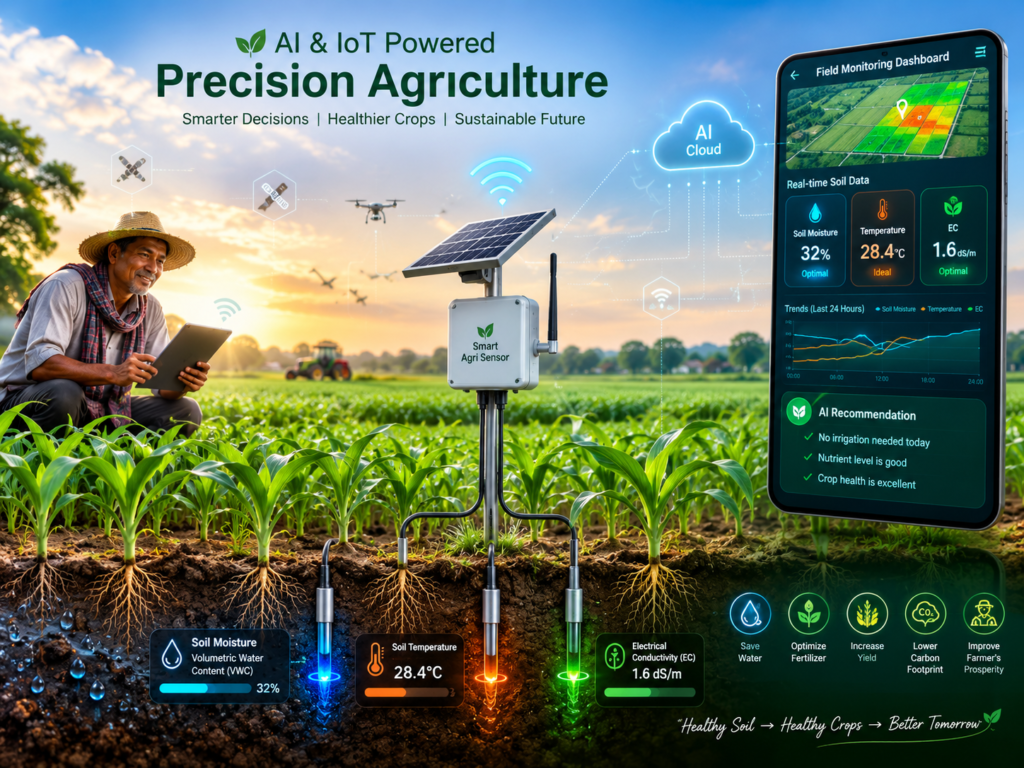
Soil does not behave uniformly across an entire farm. Moisture, temperature, salinity and nutrient-related conditions may vary considerably between plots and even within the same field.
IoT soil sensors can continuously monitor:
Volumetric soil moisture
Soil temperature
Electrical conductivity
Salinity-related conditions
Moisture at different soil depths
Irrigation response
Long-term soil-condition trends
Typical applications
Rice, vegetables, tea, fruit orchards, nurseries, horticulture, greenhouse cultivation, research farms and irrigation projects.
Business and agricultural value
Avoid unnecessary irrigation
Reduce crop stress caused by overwatering or underwatering
Understand root-zone conditions
Improve irrigation scheduling
Support soil and crop research
Reduce water and pumping cost
Generate historical field records
Recommended solution routing
Soil moisture sensors, soil temperature and EC probes, multi-depth soil sensors, LoRaWAN or cellular nodes, outdoor gateways, solar power options and cloud dashboards.
Weather Intelligence and Microclimate Monitoring
Weather information from a distant regional station may not accurately represent conditions at an individual farm.
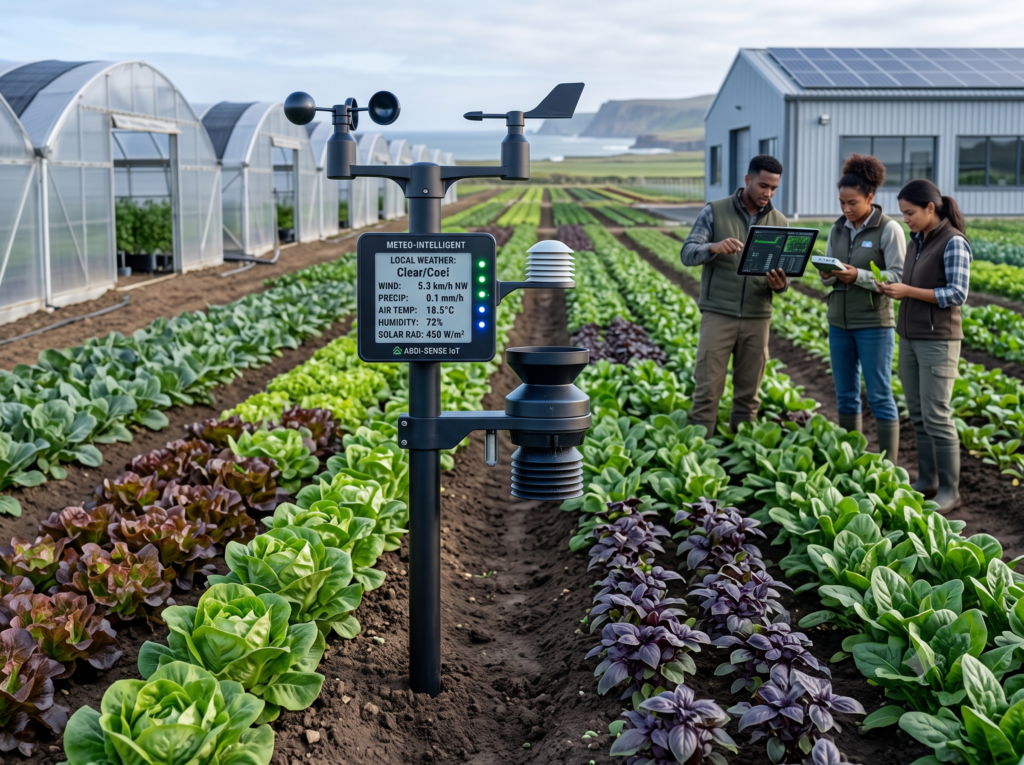
A farm-level weather station can monitor the actual microclimate affecting the crop.
Depending on the equipment selected, the system may measure:
- Air temperature
- Relative humidity
- Rainfall
- Wind speed
- Wind direction
- Barometric pressure
- Solar radiation
- Light intensity
- Leaf wetness
- Evapotranspiration-related data
Typical applications
Open fields, orchards, tea gardens, seed-production farms, irrigation schemes, research stations, agricultural universities and climate-resilience projects.
Business and agricultural value
- Improve planting and harvesting decisions
- Plan irrigation more accurately
- Identify frost, heat, storm or heavy-rain risks
- Support pesticide and fertilizer application planning
- Understand local crop-growing conditions
- Maintain weather history for analysis and reporting
Recommended solution routing
Automatic weather stations, rainfall sensors, solar radiation sensors, leaf-wetness sensors, outdoor IoT gateways, weather dashboards and SMS, email or mobile alerts.
Smart Irrigation and Water Management
Traditional irrigation frequently depends on fixed schedules or visual judgement. This can result in excess water use, insufficient watering, nutrient loss, energy waste and inconsistent crop growth.
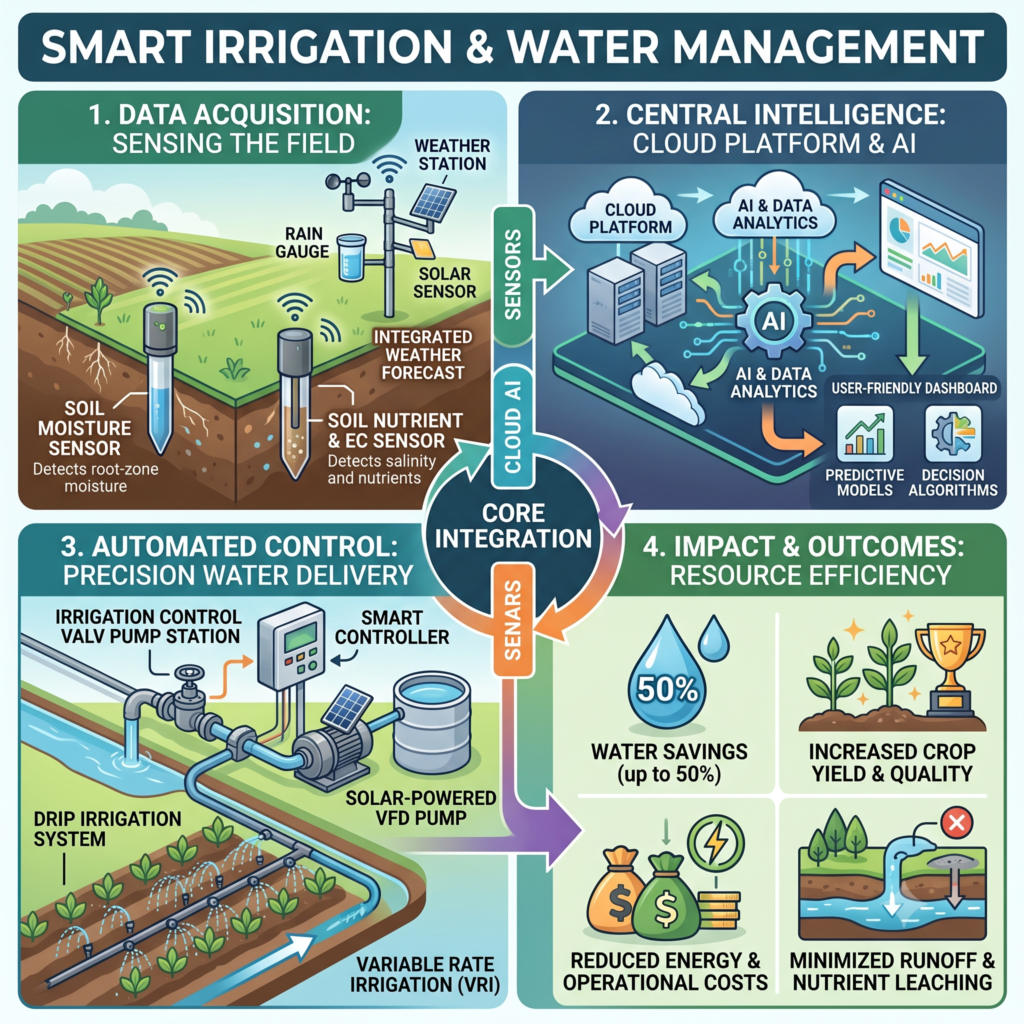
Smart irrigation combines soil information, weather data, crop requirements and automated controls to apply water more precisely.
Typical applications
Field crops, vegetable farms, orchards, nurseries, greenhouses, drip-irrigation schemes and commercial plantations.
Business and agricultural value
- Reduce unnecessary water use
- Lower pumping and electricity cost
- Maintain more consistent soil moisture
- Improve crop health
- Reduce labour dependency
- Control irrigation remotely
- Detect leakage, low pressure or pump problems
- Support zone-based irrigation
Recommended solution routing
Soil sensors, smart irrigation controllers, solenoid valves, water-flow meters, pressure sensors, pump controllers, drip irrigation, fertigation controllers and cloud-based irrigation platforms.mp problems Support zone-based irrigation
Precision irrigation can apply water and nutrients in measured quantities at the appropriate place and time. Modern platforms can also combine field, crop, soil and weather data with remote irrigation and fertigation control.
Crop Health, Disease and Pest Detection
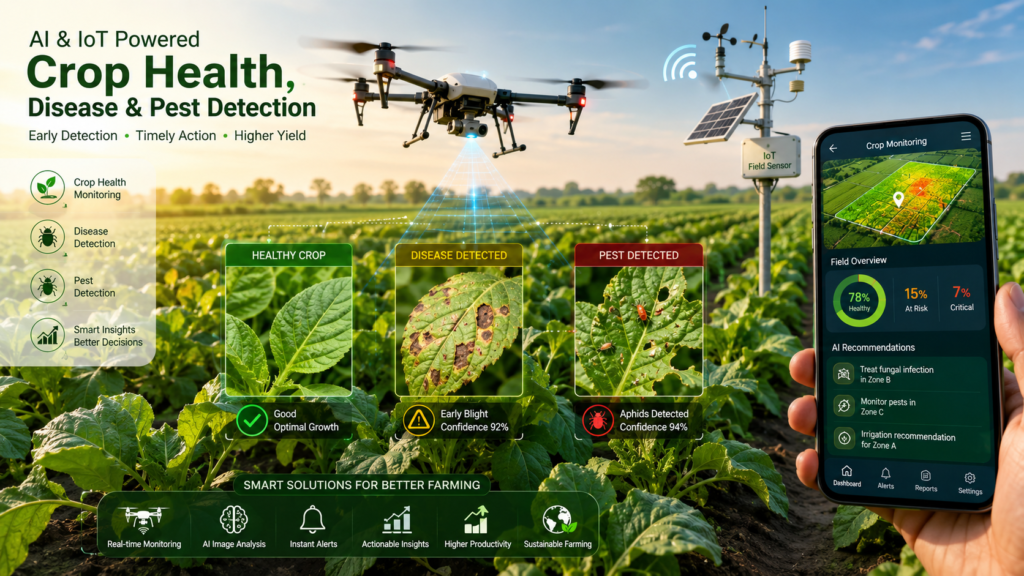
Disease, nutrient deficiency and pest damage often begin in a limited part of a field before they become visible across the crop.
AI imaging, drone surveys, smart cameras and field sensors can help identify early indications of:
- Leaf discoloration
- Abnormal crop growth
- Pest infestation
- Fungal conditions
- Water stress
- Nutrient deficiency
- Uneven plant development
- Weed concentration
Typical applications
Rice, wheat, maize, vegetables, potatoes, tea, fruit orchards, commercial crops and large agricultural estates.
Business and agricultural value
- Detect potential problems earlier
- Reduce unnecessary chemical application
- Focus field inspections on affected locations
- Improve crop-treatment decisions
- Document crop conditions over time
- Reduce the risk of widespread damage
Recommended solution routing
Multispectral drones, RGB imaging drones, AI cameras, mobile crop-diagnosis applications, satellite imagery, vegetation-index analysis and GIS-based crop maps.
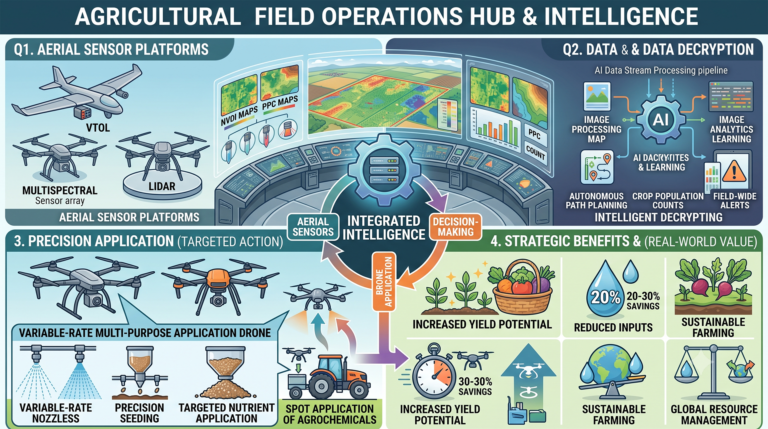
Agricultural Drones and Aerial Field Intelligence
Agricultural drones can support crop mapping, field inspection, spraying, spreading and monitoring across areas that are difficult or time-consuming to inspect manually.
Drone platforms may be used for:
- Crop-growth monitoring
- Field mapping
- Plant-count estimation
- Multispectral analysis
- Pest and disease inspection
- Precision spraying
- Seed or fertilizer spreading
- Orchard treatment
- Post-operation verification
Typical applications
Rice, wheat, maize, cotton, sugarcane, tea, fruit orchards and large commercial farms.
Business and agricultural value
- Cover large areas more quickly
- Reduce manual exposure to agricultural chemicals
- Improve application consistency
- Reach difficult terrain
- Reduce labour requirements
- Create digital maps and operating records
- Improve targeted spraying and treatment
DJI Agriculture describes its ecosystem as supporting digital and precise field management for grain and commercial crops, while its SmartFarm platform supports high-resolution farm imaging, crop-growth analysis and digital operation management.
Recommended solution routing
Agricultural spraying drones, mapping drones, multispectral cameras, RTK positioning, SmartFarm-type platforms, flight-planning tools and trained local operation and maintenance support.
Drone operation must always comply with applicable aviation, chemical-use, environmental and operator-safety requirements.
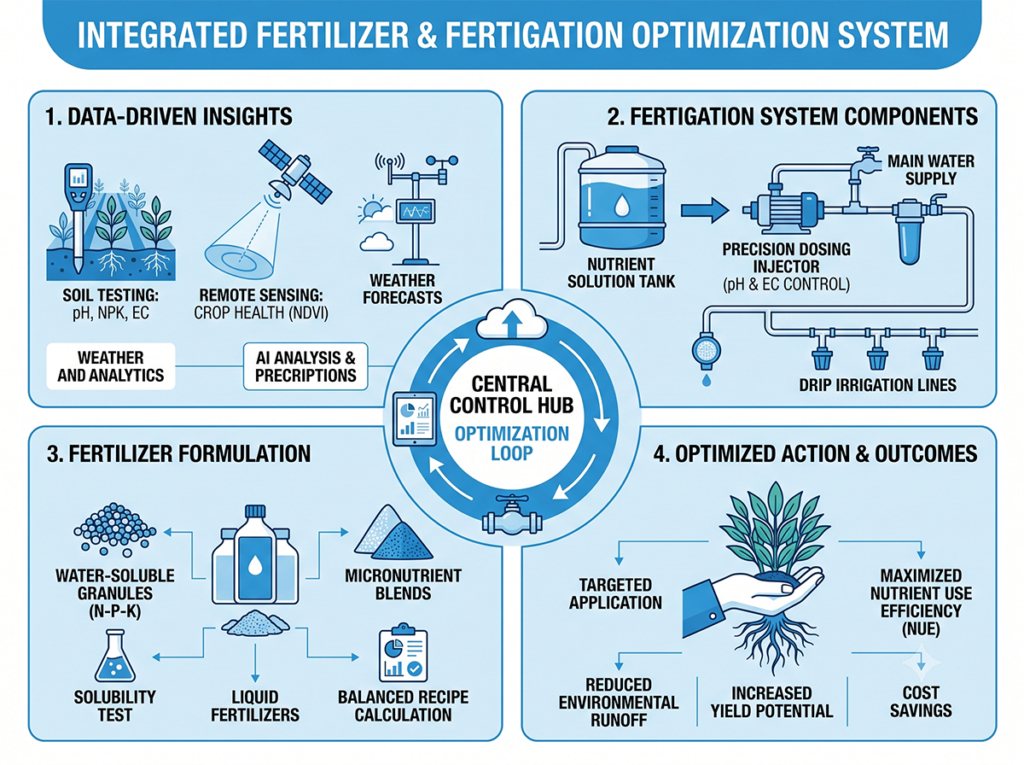
Fertilizer and Fertigation Optimization
Applying the same quantity of fertilizer across an entire field may not reflect differences in crop condition, soil properties and nutrient requirements.
Precision nutrient management can combine soil data, crop-stage information, irrigation systems and analytical recommendations.
Typical applications
Vegetables, fruit, greenhouse crops, tea, commercial plantations, nursery operations and drip-irrigated farms.
Business and agricultural value
- Reduce fertilizer waste
- Improve nutrient delivery
- Lower production cost
- Reduce runoff and environmental impact
- Improve crop uniformity
- Maintain fertigation records
- Support crop-specific nutrient programmes
Recommended solution routing
EC and pH sensors, dosing pumps, fertigation controllers, flow meters, tank-level sensors, irrigation automation, soil analysis and crop-management software.