
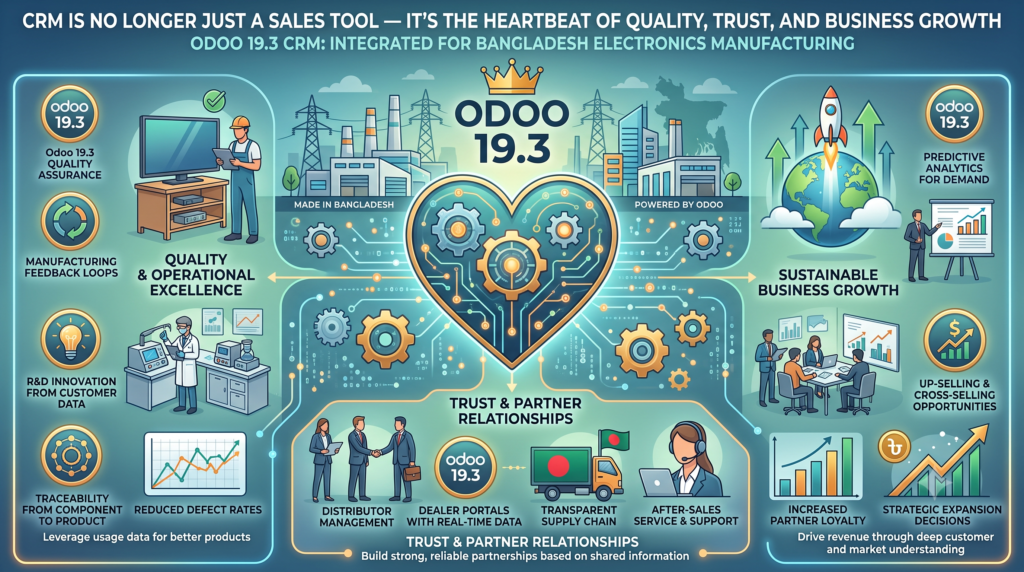
There was a time when businesses believed that selling a product was the end of the journey. Today, it’s exactly the opposite. The moment a customer makes the first inquiry, the real journey begins.
Whether you’re running a hospital, a manufacturing company, a software firm, a consulting business, or even a small online shop, one simple question determines your future:
“How well do you know your customers, and how consistently do you take care of them?”
That’s exactly where Customer Relationship Management (CRM) comes into the picture.
Many people still think CRM is just software for salespeople. In reality, CRM is much more than that. It is the organization’s memory of every interaction with its customers. It records conversations, complaints, opportunities, promises, follow-ups, quotations, meetings, contracts, and even the little details that people usually forget after a few months.
Think about visiting your favorite restaurant. You walk in, and the waiter smiles,
“Welcome back, Sir. Would you like the same coffee you ordered last week?” You instantly feel valued.
Now imagine another restaurant where nobody remembers you. Every visit feels like your first visit.
- Which one would you choose next time?
- Businesses work exactly the same way.
- Customers don’t simply buy products.
- They remember experiences.
And CRM is the system that helps organizations create those experiences consistently.
CRM Is Like the Memory of Your Organization
- Imagine your company without a CRM.
- A customer calls today.
- Another employee answers tomorrow.
- A third employee sends the quotation next week.
- Nobody knows what happened before.
- The customer repeats the same story three or four times.
- Eventually, they become frustrated and leave.
Now imagine the same situation with a properly implemented CRM.
The moment the customer calls, the employee can immediately see:
- Previous discussions
- Quotations already sent
- Pending issues
- Support tickets
- Complaints
- Purchase history
- Payment status
- Follow-up schedules
- Responsible staff
The conversation becomes smooth. The customer feels respected. The organization appears professional. Nothing important gets lost.
That is exactly what a CRM is designed to achieve.
Odoo CRM — More Than Just Managing Sales
One thing I personally like about Odoo CRM is that it doesn’t treat customers as “sales targets.” Instead, it follows the entire customer journey. From the very first inquiry until years after the customer becomes loyal, everything stays connected.
Some of its most valuable features include:
Lead Management
Every phone call…
Every email…
Every website inquiry…
Every exhibition visitor…
Every Facebook message…
can automatically become a potential business opportunity. Nothing slips through the cracks.
Opportunity Pipeline
Instead of keeping business opportunities inside people’s heads, Odoo displays them visually. For example:
New Inquiry > Qualified Lead > Meeting Scheduled > Proposal Sent > Negotiation > Won
or
Lost
Managers immediately know:
“Where is every potential customer right now?” No guessing. No chasing spreadsheets.
Customer Communication History
- Every email…
- Meeting…
- Phone call…
- Internal note…
- Document…
- Quotation…
can be linked to the same customer record. Months later, anyone can understand the complete story without asking ten different people.
Follow-up Activities
Let’s be honest. Human beings forget things. CRM doesn’t.
It reminds employees:
- Call tomorrow
- Send proposal Friday
- Visit customer next week
- Renew contract next month
Simple reminders often save millions in lost business.
Quotation Management
Generating quotations becomes much faster because customer information already exists inside the system. Sales teams spend less time typing. More time building relationships.
Forecasting
Managers don’t have to rely on intuition anymore. CRM can estimate:
- Expected revenue
- Conversion rates
- Sales trends
- Team performance
This makes planning much more realistic.
Integration with Other Business Functions
This is where Odoo becomes especially powerful. CRM isn’t isolated. It connects naturally with:
- Sales
- Accounting
- Inventory
- Marketing
- Helpdesk
- Project Management
- Email Marketing
- Customer Support
Instead of separate software speaking different languages, everyone works from the same source of truth.
Where CRM Meets ISO 9001:2015
Now comes the interesting part. Many organizations implement ISO 9001 and CRM separately. Personally, I think that’s a missed opportunity. Because if you read ISO 9001 carefully, you’ll notice something important. The standard isn’t asking organizations to buy software.
It’s asking them to consistently understand customers, meet requirements, improve processes, and make decisions using evidence.
A good CRM naturally supports many of these objectives.
Understanding Customer Needs
ISO 9001 begins with customer focus. An organization cannot satisfy customers if it doesn’t understand them. CRM captures:
- Customer expectations
- Requirements
- Preferences
- Purchase patterns
- Communication history
Instead of relying on memory, the organization relies on documented information. That immediately strengthens consistency.
Better Customer Communication
One of the common reasons customers become unhappy isn’t poor products. It’s poor communication. “We didn’t receive your quotation.”
“No one called us.”
“I already reported this.”
CRM records every interaction. Everyone sees the same information. Communication becomes reliable rather than dependent on individuals.
Handling Complaints Properly
Every complaint is actually free consultancy. It tells us what needs improvement. CRM allows organizations to record:
- Complaints
- Root causes
- Actions taken
- Follow-up status
- Customer feedback after resolution
Instead of solving problems repeatedly, organizations begin eliminating the causes. That is exactly the philosophy behind continual improvement.
Evidence-Based Decision Making
Managers often say, “I think customers are happy.” But ISO encourages decisions based on evidence. CRM provides measurable information like:
- Response times
- Win rates
- Complaint trends
- Lost opportunities
- Customer satisfaction
- Conversion percentages
Now decisions become fact-based rather than opinion-based.
Continual Improvement
Over time, CRM begins revealing patterns. Maybe customers from one industry always request faster delivery. Maybe one sales representative consistently closes more deals. Maybe one product receives repeated complaints.
These insights become valuable inputs for improvement initiatives.
Where CRM Supports ISO 27001:2022
Now let’s look from another angle. CRM contains one of the organization’s most valuable assets:
Customer information.
- Names.
- Phone numbers.
- Email addresses.
- Contracts.
- Commercial negotiations.
- Pricing.
- Purchase history.
- Support records.
Sometimes even personal or confidential information. If this data falls into the wrong hands, the damage can be enormous. That’s why CRM is also closely connected with the objectives of ISO 27001.
Access Control
Not everyone should see everything. A finance officer doesn’t necessarily need confidential sales negotiations. A marketing executive shouldn’t edit customer contracts. Modern CRM systems allow organizations to define who can view, edit, approve, or delete information. This protects confidentiality while allowing people to perform their jobs efficiently.
Protecting Customer Information
Imagine losing your complete customer database overnight. Years of relationships… gone. Regular backups, secure authentication, encryption, and controlled access help reduce that risk. Protecting customer information is not just good IT practice—it protects the trust customers place in the organization.
Audit Trai
One of the most useful features in modern business systems is the audit trail. Instead of asking, “Who changed this quotation?” – the system already knows.
It records:
- Who changed it
- When it changed
- What was changed
That level of accountability supports stronger governance and easier investigations when something goes wrong.
Managing Information Throughout Its Lifecycle
Customer information should not remain forever without purpose. Some records must be retained. Others should eventually be archived or securely disposed of, depending on business, legal, and contractual requirements. Good information lifecycle management reduces unnecessary risk while keeping valuable records available when needed.
Business Continuity
- Imagine a server failure on Monday morning.
- Sales teams cannot access customer records.
- Support staff cannot answer calls.
- Management cannot see pending opportunities.
- Business almost comes to a standstill.
Regular backups, disaster recovery arrangements, and tested recovery procedures help ensure that customer services can continue even when unexpected incidents occur. This aligns well with the resilience objectives that organizations strive for in their information security management systems.
The Bigger Picture
When people hear “CRM,” they often think about increasing sales. That’s certainly one benefit. But after working with organizations across healthcare, banking, manufacturing, software companies, and consulting projects, I’ve come to see CRM as something much bigger.
A well-managed CRM helps an organization:
- remember every customer,
- communicate consistently,
- learn from complaints,
- improve services,
- protect valuable information,
- make better decisions,
- and build trust over many years.
That sounds remarkably similar to what both ISO 9001:2015 and ISO/IEC 27001:2022 are trying to achieve. One focuses on delivering consistent quality and enhancing customer satisfaction. The other focuses on protecting the information that customers entrust to the organization. Together, they create a simple but powerful message:
Know your customers. Serve them consistently. Protect their information. Keep improving every day.
And that’s exactly what a well-implemented CRM—such as Odoo CRM—helps organizations do.
A Final Thought
Technology alone never builds customer relationships. People do. But the right technology helps good people do their jobs better. A CRM doesn’t replace conversations, empathy, or trust. It simply makes sure those valuable interactions are remembered, followed up, measured, and continually improved. When CRM is implemented alongside the principles of ISO 9001:2015 and ISO/IEC 27001:2022, it stops being just another software module. It becomes part of the organization’s quality culture and information security culture—a foundation for long-term customer confidence and sustainable business growth.