
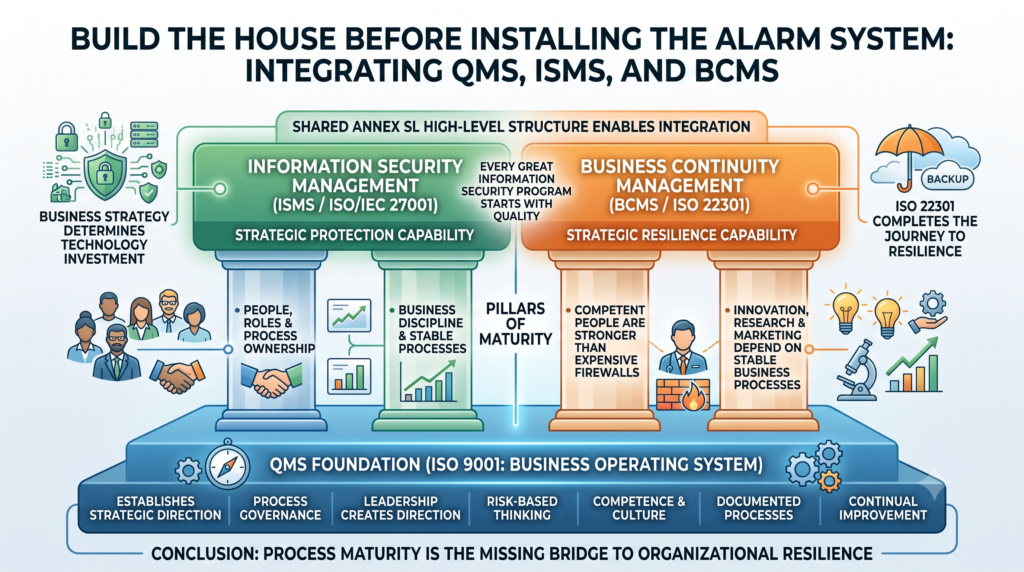
ISO 9001 establishes strategic direction, process governance, leadership, risk-based thinking, competence, documented processes, and continual improvement, making it the logical platform upon which ISO/IEC 27001 and ISO 22301 can be integrated. Both standards also share the same Annex SL high-level structure, which deliberately enables integration.
I would organize some relevant key points first roughly like this:
- Why Every Great Information Security Program Starts with Quality
- Quality is Not About Documents—It Is About Business Discipline
- Leadership Creates Direction Before Security Creates Protection
- People, Roles and Process Ownership Come Before Security Controls
- Business Strategy Determines Technology Investment
- Competent People Are Stronger Than Expensive Firewalls
- Innovation, Research and Marketing Depend on Stable Business Processes
- Process Maturity: The Missing Bridge Between ISO 9001 and ISO 27001
- ISO 22301 Completes the Journey from Quality to Organizational Resilience
- Conclusion: Build the House Before Installing the Alarm System
The following are bit more explanation of the core objectives being discussed:
- Leadership strategic direction—showing that executives first define where the organization is going before deciding how to protect information.
- Business optimization and people engagement—explaining that clearly defined processes, realistic responsibilities, and engaged employees make security practical rather than bureaucratic.
- Strategic investment based on business risk—demonstrating that organizations should invest in infrastructure because it supports business objectives and competitive advantage, not merely because a standard requires it.
- Competency and emerging technology—highlighting that AI, cloud, cybersecurity, ERP, analytics, automation, and digital transformation demand continuous learning from employees, suppliers, and partners.
- Research, innovation, and marketing—illustrating that quality-driven organizations continuously improve products, study markets, understand customers, and innovate while protecting intellectual property and ensuring business continuity.
Finally, I would conclude with a message that many executives overlook:
“Organizations do not become secure by purchasing cybersecurity tools. They become secure by becoming mature organizations. A mature organization understands its business, knows its processes, develops competent people, manages risks intelligently, and continually improves. That is exactly why ISO 9001 is so often the first management system implemented worldwide. It builds the organizational discipline that allows ISO/IEC 27001 and ISO 22301 to succeed—not as isolated certifications, but as integrated business capabilities.”
I believe this could become one of your strongest ISO blogs because it connects business strategy, quality, information security, business continuity, and process maturity into a single story that executives, auditors, consultants, and business leaders can all relate to. It also aligns closely with the strategic intent of ISO 9001:2015 and ISO/IEC 27001:2022, which emphasize leadership, integration into business processes, risk-based thinking, competence, resources, and continual improvement as the foundation of effective management systems.