
Many organizations start implementing ISO 9001:2015 by writing procedures, preparing documents, and creating different forms. At first, it seems like this is the right place to begin.
But actually, ISO 9001 starts somewhere else.
It starts with understanding the organization itself.
This is probably one of the most overlooked requirements of ISO 9001:2015. Yet, it is one of the most important foundations of a Quality Management System (QMS). If this foundation is weak, every process built on top of it becomes weak too.
Let’s look at it in a simple way.
What does “Context of the Organization” really mean?
Think of it like this.
Before building a house, an engineer studies the land. Is it soft? Is it rocky? Does it flood during the rainy season?
Without knowing these things, the building may not stand for long.
ISO 9001 asks an organization to do exactly the same.
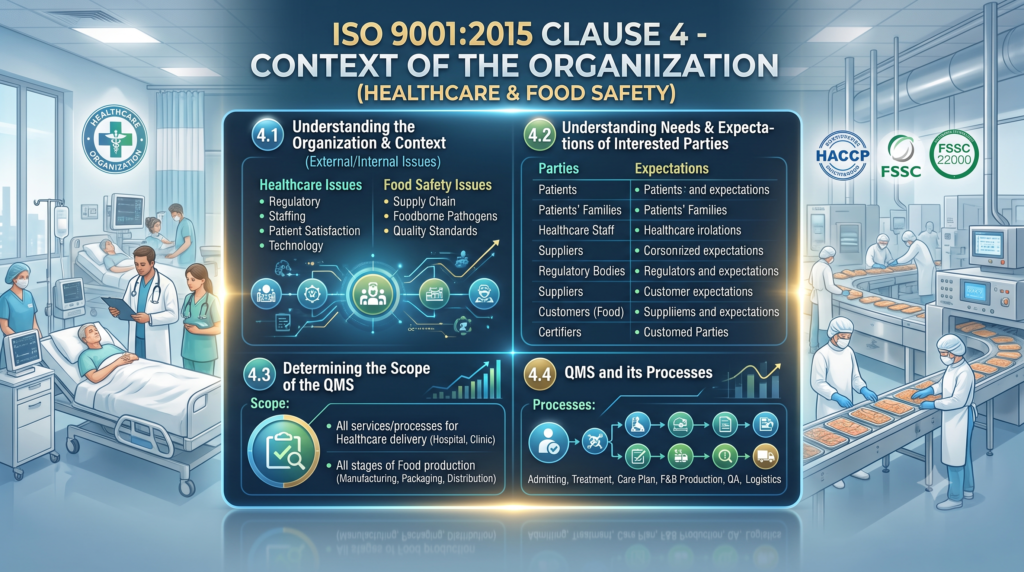
Before designing the QMS, the organization must understand:
- Who are we?
- What kind of business are we doing?
- What internal issues affect us?
- What external issues affect us?
- Who are our interested parties?
- What do they expect from us?
Only after understanding these questions can a meaningful Quality Management System be developed.
Understanding Internal and External Context
The context of an organization has two sides.
Internal Context
These are the issues inside the organization.
For example:
- Leadership commitment
- Employee competency
- Organizational culture
- Financial capability
- Technology
- Equipment
- Infrastructure
- Existing processes
- Knowledge and experience
Imagine a hospital.
If the nurses are well trained but the medical equipment is outdated, that becomes an important internal issue.
Similarly, in a food manufacturing company, if workers are experienced but the production machines frequently break down, that also becomes an internal issue affecting quality.
External Context
These are factors outside the organization.
For example:
- Government regulations
- Market competition
- Customer expectations
- New technologies
- Economic conditions
- Environmental requirements
- Social changes
- Supplier performance
Suppose a hospital operates in a city where patients now expect online appointments and digital medical records.
That external expectation directly affects how the hospital should improve its services.
Likewise, if a food manufacturer exports products, changing food safety regulations in another country immediately becomes an external issue that cannot be ignored.
How Can We Measure These Contexts? (Their KPIs)
Many people think context is only a discussion.
Actually, it should also be monitored.
Some useful KPIs can help management understand whether the internal and external context is improving or creating risks.
Internal Context KPIs
Examples include:
- Employee turnover rate
- Staff competency level
- Training effectiveness
- Equipment downtime
- Internal audit findings
- Customer complaints
- Process efficiency
- Employee satisfaction
For example, if a hospital keeps receiving complaints about long waiting times, that tells management there is an internal process issue.
Similarly, if a food factory frequently experiences machine breakdowns, production quality and delivery schedules will eventually suffer.
External Context KPIs
Examples include:
- Customer satisfaction
- Market share
- Regulatory compliance status
- Supplier performance
- Number of legal changes
- Competitor activities
- Economic trends
- Community feedback
These indicators help management understand whether the outside world is changing and whether the organization is adapting quickly enough.
Why Does Context Shape the Entire QMS?
This is probably the most important question.
The Quality Management System should never be copied from another organization.
Every organization is different.
A hospital and a food manufacturing company may both be ISO 9001 certified, but their quality risks, customers, legal requirements, and operational challenges are completely different.
Because of that, their Quality Management Systems must also be different.
For example:
A hospital focuses on:
- Patient safety
- Clinical competency
- Infection prevention
- Emergency response
- Confidential patient information
A food manufacturer focuses on:
- Food safety
- Raw material quality
- Hygiene
- Packaging
- Shelf life
- Product traceability
Both follow the same ISO 9001 standard.
But their QMS looks very different because their organizational context is different.
What Happens If Context Is Not Properly Identified?
This is where many ISO implementations fail.
When the organization skips this step, the QMS becomes nothing more than paperwork.
You may see:
- Procedures that nobody follows
- Objectives that have no business value
- Risks that were never identified
- Customer complaints repeating every month
- Internal audits finding the same problems again and again
- Management Reviews discussing the wrong priorities
Eventually, employees start believing that ISO is just documentation instead of a tool for improving the business.
In reality, the problem is not ISO.
The problem is that the organization never understood itself before building the system.
How Does Context Affect Other ISO 9001 Requirements?
One beautiful thing about ISO 9001:2015 is that everything is connected.
Once the organizational context is correctly identified, many other requirements become much easier.
For example:
Quality Policy should reflect the organization’s purpose and direction.
Quality Objectives should address the challenges identified in the context.
Risk and Opportunity Management depends on understanding internal and external issues.
Resource Planning depends on business needs and future expectations.
Competency Planning depends on organizational goals.
Operational Controls depend on customer and regulatory requirements.
Performance Evaluation measures whether the organization is responding effectively to its context.
Even Continual Improvement begins by understanding what is changing inside and outside the organization.
That is why Clause 4 sits near the beginning of ISO 9001—it sets the direction for almost everything that follows.
Why Do Interested Parties Matter So Much?
ISO 9001 does not only ask organizations to think about customers.
It asks them to identify all interested parties and understand their needs and expectations.
These may include:
- Customers
- Employees
- Government regulators
- Owners
- Suppliers
- Local communities
- Insurance companies
- Accreditation bodies
- Investors
Each of them has expectations.
A patient expects safe treatment.
A food consumer expects safe and healthy products.
Employees expect a safe workplace and fair treatment.
Regulators expect legal compliance.
Suppliers expect timely payment and clear communication.
If these expectations are not understood, the organization may satisfy one group while disappointing another.
A balanced QMS considers all of them.
The Final Thought
From my experience in auditing different organizations—from hospitals and diagnostic centers to manufacturing companies and software firms—I have noticed one common pattern.
Organizations that truly understand their context usually build practical, useful, and sustainable Quality Management Systems.
On the other hand, organizations that treat Clause 4 as just another document often struggle later with risk management, quality objectives, customer satisfaction, and continual improvement.
In simple words, the context of the organization is the compass of the Quality Management System.
If the compass points in the wrong direction, every process that follows may also head the wrong way.
So before writing procedures, designing forms, or preparing for certification, spend time understanding your organization, the environment in which it operates, and the people who matter most.
A strong QMS doesn’t begin with documents—it begins with understanding the business itself.